Why Anxious Attachment Mistakes Activation For Love

You know this feeling, maybe better than you know calm.
The racing pulse when their name shows up.
The stomach that won’t settle until they respond.
The restless, electric pull toward checking, wondering, replaying the last conversation for clues about the next one.
It feels enormous.
It feels like proof.
Surely something this intense, this consuming, this hard to ignore, has to mean you’ve found something real.
So you call it love.
Or the start of it.
The most alive you’ve felt in months, maybe years — and isn’t that supposed to mean something.
Here’s the part that’s hard to hear and important to understand: intensity like this isn’t always love finding you. Sometimes it’s your nervous system sounding an alarm, and nobody ever taught you the two can feel almost identical from the inside.
You’ve been using intensity as your only measure of real feeling
It makes sense that you’d measure it this way.
Intensity is the loudest, most undeniable thing you have direct access to.
You can feel your heart racing.
You can feel the pull to check your phone.
You can’t feel, in the moment, the difference between excitement and alarm, because physiologically, they’re built from a lot of the same raw material.
So the size of the feeling becomes the proof of its meaning.
The bigger it feels, the more real it must be.
Anything calmer, by comparison, can start to feel like something is missing — not enough spark, not enough chemistry, not the real thing.
This measurement isn’t a personal failing.
It’s just an incomplete one, because intensity was never actually built to tell you what it’s about.
It just tells you something’s happening.
It doesn’t specify what.
You weren’t wrong that you felt something enormous. You were just never taught that “enormous” and “love” aren’t automatically the same word.
But activation and love are not the same event, even though they can feel identical
Here’s the reframe.
What you’re calling love, in these moments, is often activation — your nervous system’s alarm response to unpredictability, inconsistency, or uncertainty about where you stand.
It produces many of the same physical sensations as genuine attraction, which is exactly why it’s so easy to mistake for the real thing.
Racing heart, restless attention, a compulsive pull to check and confirm — these aren’t unique to love.
They’re the standard signature of a nervous system trying to resolve uncertainty about something that matters to it.
A person who is warm one day and distant the next, who is hard to predict, who keeps you slightly unsure of your footing, will reliably produce this exact physiological signature — regardless of whether real compatibility, real safety, or real love is anywhere in the picture.
Genuine attraction can absolutely include excitement.
But it isn’t built primarily from alarm.
It doesn’t require uncertainty to sustain itself.
It doesn’t need the other person to be unpredictable in order to keep your attention.
The size of the feeling was never in question. What it’s actually made of was — and alarm dressed as longing is one of the easiest mix-ups a nervous system makes.
What’s actually happening in the body during this kind of activation
This isn’t just a way of talking about it.
It’s a specific, well-documented physiological pattern.
Uncertainty about connection — will they respond, do they still want this, where do I actually stand — activates the same stress-response systems involved in any perceived threat to something you need.
Your body doesn’t have a separate alarm system just for relationships.
It uses the same one it uses for everything else that feels urgent and unresolved.
This produces a genuine physiological state: elevated heart rate, a spike in attention toward anything related to the source of uncertainty, a compulsive pull to check for resolution.
This state is not subtle, and it demands attention in a way that feels a lot like desire, because desire and alarm share so much of the same machinery.
Crucially, this activation gets stronger with more unpredictability, not less.
A person who is consistent and available produces less of this charge over time, not more — which is exactly why steady, secure connection can feel, confusingly, less “intense” than an unstable one.
The nervous system isn’t sounding the alarm as often, because there’s less to be alarmed about.
The racing heart wasn’t measuring how much you loved them. It was measuring how uncertain you were about where you stood — and those are two very different things that happen to feel almost the same.
Why mistaking activation for love keeps you stuck in the same pattern
If you keep reading intensity as proof of a real connection, you end up drawn, again and again, toward exactly the dynamics that produce the most activation — the inconsistent, the unpredictable, the hard-to-read — because those are the ones that will always feel the most “alive.”
Meanwhile, steadier, more available people can start to feel, unfairly, like something’s missing.
Not enough spark or enough chemistry.
When what’s actually missing is simply the alarm response you’d learned to interpret as desire.
This keeps you cycling through connections that feel enormous and leave you depleted, while overlooking the ones that feel calmer and might actually be sustainable — because you’ve been sorting for intensity instead of sorting for what intensity was actually made of.
Chasing activation doesn’t get you closer to love. It gets you closer to more alarm, dressed convincingly enough that you keep mistaking it for the thing you actually want.
The distinction that actually matters here
Not every strong pull toward someone is the same, and this is the entire skill worth building.
There’s activation, and there’s attunement.
Activation is built from uncertainty.
It spikes with inconsistency, quiets briefly with reassurance, and spikes again the moment that reassurance fades.
It needs the other person’s unpredictability to keep running, even if you’d never consciously want them to be unpredictable.
Attunement is built from actual, accumulating safety.
It doesn’t need uncertainty to sustain itself — it grows quieter and steadier over time, not because the feeling fades, but because the nervous system stops needing to sound an alarm about something it’s learned to trust.
Activation feels like a rollercoaster you can’t get off.
Attunement feels like ground that’s actually there when you step on it.
If the feeling gets bigger every time they pull away and calmer every time they come back, that’s activation. If the feeling stays steady whether they’re near or far, that’s attunement — and attunement is the only one of the two built to last.
What actually needs to shift here
The shift isn’t learning to distrust every strong feeling you have, and it isn’t deciding that calm is automatically better than exciting. That overcorrection creates its own problems.
The real shift is learning to ask, honestly, what the intensity is actually made of before naming it. Is this steady, or is this a spike.
Is this growing because I feel safer, or because I feel less sure.
The size of the feeling was never the useful data point.
What’s generating it is.
This means, in practice, noticing whether your peace depends on their next response, or whether it holds regardless of what they do next.
One of those is regulation building on real ground.
The other is alarm, waiting for the next uncertain moment to sound again.
You don’t need to feel less. You need to know what you’re actually feeling — because alarm and love have never been the same event, even on the days they happen to feel identical.
What this looks like in the body, not just the idea
This is physical, not just conceptual.
Activation has a specific signature — a spike right when contact goes quiet, a relief that feels less like ease and more like a held breath finally released, a pattern that repeats every time uncertainty reappears.
It’s felt as urgency more than warmth.
Attunement feels different.
It’s steadier, quieter, less dependent on the next message.
There’s a baseline calm that doesn’t need to be constantly re-earned through reassurance.
You’ll know you’ve actually started telling the difference when you notice a spike of feeling and, instead of automatically calling it love, you pause and ask what it’s actually responding to — uncertainty, or genuine safety.
That’s the tell. Not how big the feeling is. What it’s actually built from.
Anxious attachment mistaking activation for love was never a sign that you feel too much, or want too badly, or love the wrong way.
It’s what happens when a nervous system’s alarm signal and its signal for genuine connection get filed under the same name, because nobody ever taught you they were different files to begin with. You’re allowed to feel intensity. You’re just allowed, finally, to ask what it’s actually made of — because only one version of that feeling was ever built to hold something real, and it was never the one that needed uncertainty to survive.
If this is the layer you’re ready to understand fully
This post is one piece of a much larger map.
Press enter or click to view image in full size
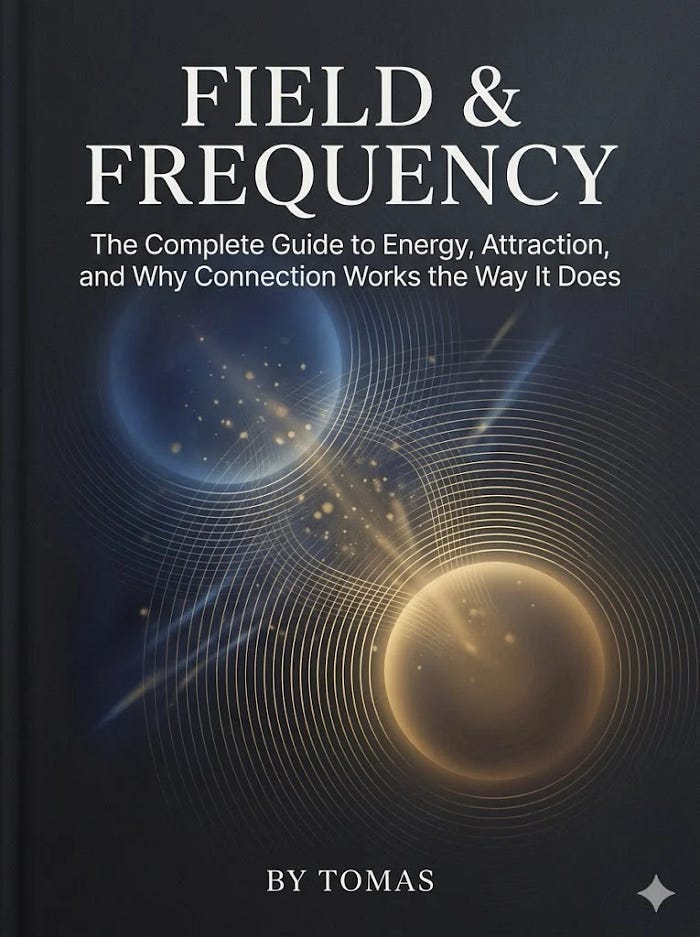
This ebook goes deeper into how activation and attunement actually differ at the nervous system level, why anxious attachment consistently mistakes one for the other, and how to build the kind of internal ground where you can finally tell real connection from a well-disguised alarm.
Available here on Gumroad.
— — —
Work with me one on one — book a free session
If you suspect you’ve been chasing activation and calling it love, let’s look at it together.
Book a free session here.
— — —
Join the free inner circle
Weekly writing on presence, nervous system regulation, and the quiet mechanics of real connection.
Download my free guides here to join.
Related Articles:
- Why "Manifesting Them" Is Actually Making It Worse
- The Shadow Side of Sensitivity: Why Your “Intuition” is Actually a Trap
- Why You Keep Misreading the Signal (And How to Finally Read It Clearly)
About the Author:
For over thirteen years, Tomas has conducted deep research in nervous system science, chakras, field mechanics, relational dynamics, human attachment/imprint and remote connection.
He specializes in helping individuals move past the exhausting performance of healing and step into genuine internal sovereignty by getting brutally honest about reality.
He also works with individuals stuck in limbo relationships to understand what’s actually happening beneath the surface — and how to break free.
Through his writing and coaching/guidance, he helps people distinguish authentic remote connection from psychological fantasy.